Showing posts with label Saturday's Critters. Show all posts

Thursday, May 4, 2017

Wild Bird Wednesday: Rufous Whistler

The Rufous Whistler is a stocky bird with a large head, short stubby bill and a narrow, relatively long tail with a square or slightly forked tip. The sexes differ, with the male dark-grey above with a white throat, black breast and a reddish underbody. Many males also have a black face mask (except in northern subspecies). Females are dull grey to brown, with streaked underparts. Young birds are much redder than adults and have heavily streaked underparts.

The male Rufous Whistler is quite distinctive with its reddish underparts, grey head and white throat, combined with black mask (over most of range). The female and immature birds can be distinguished from most other whistlers by heavy streaking on the underparts.


The Rufous Whistler is found in forests, woodlands and shrublands, with a shrubby understorey. Is also found in gardens and farmland with some trees, and in remnant bushland patches.


Linking up with these memes:


Wednesday, April 5, 2017

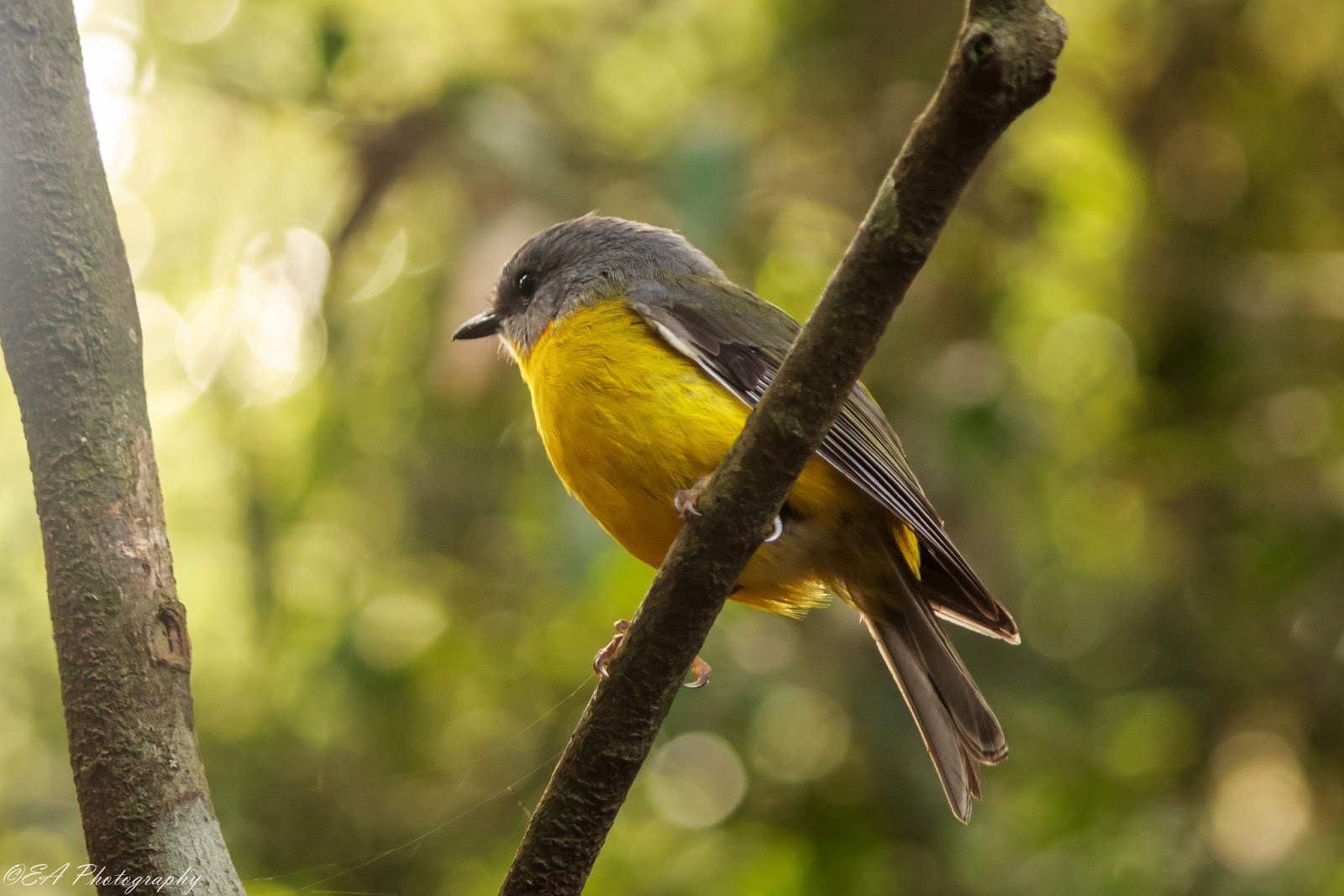
Wild Bird Wednesday: Eastern Yellow Robin

The Eastern Yellow Robin is a medium sized robin. It has a grey back and head, and yellow underparts. Southern birds have an olive-yellow rump, while in northern birds it is brighter yellow. The throat is off-white and, in flight, there is a pale off-white wing bar. The bill is black. Both sexes are similar in plumage colour and pattern, but the female is slightly smaller. Young Eastern Yellow Robins are rufous-brown. The plumage has some paler streaks, which are confined to the wings when the birds are a little older.

The Eastern Yellow Robin is confined to the east and south-east of the Australian mainland. The range is mostly along the coastal and adjacent areas, but does extend quite large distances inland in some areas. Eastern Yellow Robins are found in a wide range of habitats, from dry woodlands to rainforests. They are also common in parks and gardens, and are usually first seen perched on the side of a tree trunk or other low perch.


Linking up with these memes:


Tuesday, March 21, 2017

Wild Bird Wednesday: Scaly-breasted Lorikeet

The Scaly-breasted Lorikeet is Australia’s second-largest species of lorikeet, behind the Rainbow Lorikeet. Instead of the Rainbows’ vivid coloration, Scaly-breasted Lorikeets are mostly emerald-green, with yellow scalloping on the front (the ‘scales’) and a coral-pink bill.


Like other lorikeets, they almost exclusively eat nectar which is usually gathered from the flowers eucalypts, banksias, paperbarks and other native trees and shrubs. These lorikeets often associate with other species of nectar-eating birds, especially Rainbow Lorikeets, and they are often seen squabbling noisily with them in the canopy of flowering trees.


Linking up with these memes:


Thursday, March 9, 2017

Wild Bird Wednesday: Laughing Kookaburra

The Laughing Kookaburra is instantly recognisable in both plumage and voice. It is generally off-white below, faintly barred with dark brown, and brown on the back and wings. The tail is more rufous, broadly barred with black. There is a conspicuous dark brown eye-stripe through the face. It is one of the larger members of the kingfisher family.


Laughing Kookaburras feed mostly on insects, worms and crustaceans, although small snakes, mammals, frogs and birds may also be eaten. Prey is seized by pouncing from a suitable perch. Small prey is eaten whole, but larger prey is killed by bashing it against the ground or tree branch.

Laughing Kookaburras are found throughout eastern Australia. They have been introduced to Tasmania, the extreme south-west of Western Australia, and New Zealand.
The Laughing Kookaburra inhabits most areas where there are suitable trees.


Linking up with these memes:


Wednesday, April 27, 2016

Wild Bird Wednesday: Sacred Kingfisher

The Sacred Kingfisher is a medium sized kingfisher. It has a turquoise back, turquoise blue rump and tail, buff-white underparts and a broad cream collar. There is a broad black eye stripe extending from bill to nape of neck.
Both sexes are similar, although the female is generally lighter with duller upper parts. Young birds are similar to the female, but have varying amounts of rusty-brown edging to feathers on the collar and underparts, and buff edges on the wing coverts.


The Sacred Kingfisher is common and familiar throughout the coastal regions of mainland Australia and less common throughout Tasmania. The species is also found on islands from Australasia to Indonesia and New Zealand.

The Sacred Kingfisher inhabits woodlands, mangroves and paperbark forests, tall open eucalypt forests and melaleuca forests.

Info from: Birds In Backyards


Linking up with these memes:


Wednesday, March 16, 2016

Wild Bird Wednesday: Sharp-tailed Sandpiper

The township of Beachmere, tucked away in the northern section of Moreton Bay, is a quiet yet pleasant hideaway. 
Its location, north of Brisbane just above Deception Bay, where the mouth of the Caboolture River flows into the bay, makes it an ideal spot for boating, fishing and birdwatching. You can also enjoy watching millions of tiny soldier crabs scuttling along the mud flats at low tide.

The Sharp-tailed Sandpiper is a medium sized wader with a straight black bill that has an olive-grey base. It has a chestnut crown and nape, a white eyebrow, and reddish brown upperparts, with each feather having a black centre. The rump and tail are black, with white outer margins visible in flight. The wings have an indistinct white bar. The breast and flanks are white, streaked and speckled black, with a reddish brown tinge on the chest, grading into a white belly and undertail. The legs are olive. This species is commonly seen with other waders during its migration from northern breeding grounds.


Out at Beachmere, we also spotted many other birds including, Osprey, Black-winged Stilts, Eastern Curlew, Curlew Sandpipers, Great Knots, Gull-billed Terns, White-faced Herons, and more.


Linking up with these memes:


Wednesday, March 9, 2016

Wild Bird Wednesday: Eastern Yellow Robin

The Eastern Yellow Robin is a medium sized robin. It has a grey back and head, and yellow underparts. Southern birds have an olive-yellow rump, while in northern birds it is brighter yellow. The throat is off-white and, in flight, there is a pale off-white wing bar. The bill is black. Both sexes are similar in plumage colour and pattern, but the female is slightly smaller. Young Eastern Yellow Robins are rufous-brown. The plumage has some paler streaks, which are confined to the wings when the birds are a little older.

Juvenile Eastern Yellow Robin in the D'Aguillar Ranges


Adult Eastern Yellow Robin taken in O'Reilly's Rainforest


Linking up with these memes:


Sunday, February 14, 2016

Beauty & the "Beast"

"The earth laughs in flowers." ~ Ralph Waldo Emerson


A quiet stroll in the gardens, in the warm afternoon sun.

Camera in hand, capturing the beauty of nature around me.


Colour abounds around every corner...

The intricate details, an incredible sight.

I step back a little for a different perspective.

And then I see it:
Something entirely different, among the beauty; lazing in the warm afternoon sun, almost prehistoric looking. He too, is enjoying the beauty of nature.

His elaborate details and patterns, proof that creation isn't just an accident but the handiwork of God, the Master Creator.

PS. I don't really think he's a beast! I find Eastern Water Dragons fascinating!


Linking up with these memes:

        http://floralfridayfoto.blogspot.com.au/            

Related Posts Plugin for WordPress, Blogger...