It's been a while since I posted. My husband Michael had emergency spinal surgery in early September, so blogging, day trips and photography have been put on hold.
Thankfully he got one of the top Neurosurgeons in Brisbane and his surgery has been a great success. I thank God for everything falling into place!
I decided that my first post back would be to share the importance of the little things in life and how that should always be our focus; they are the things that bring true happiness.
If happiness was determined by big meaningful events, then it would be difficult to continuously achieve. It is the small, and often unexpected, pleasures in life that can make us smile each and every day to help us build happier and more meaningful lives for ourselves and for others.
Small victories, random acts of kindness, a smile from a stranger, reading a book, laughter, a genuine hug, receiving an email or message from a friend, watching a sunset, small unexpected surprises, listening to your favourite music...
"Perfect happiness is a beautiful sunset, the giggle of a grandchild, the first snowfall. It's the little things that make happy moments, not the grand events. Joy comes in sips, not gulps."
-- Sharon Draper
Linking up with these memes:
Showing posts with label birds. Show all posts
Thursday, November 2, 2017
Wednesday, June 28, 2017
Wild Bird Wednesday: Eastern Osprey
The Osprey is a medium-sized fish-eating raptor (bird of prey). It has dark brown upper-parts contrasting with pale underparts. There is a black band through the eye, separating the white throat from the pale crown.
Ospreys are found on the coast and in terrestrial wetlands of tropical and temperate Australia and off-shore islands, occasionally ranging inland along rivers, though mainly in the north of the country.
Excuse me.......
Linking up with these memes:
Ospreys are found on the coast and in terrestrial wetlands of tropical and temperate Australia and off-shore islands, occasionally ranging inland along rivers, though mainly in the north of the country.
Excuse me.......
Linking up with these memes:
Thursday, May 4, 2017
Wild Bird Wednesday: Rufous Whistler
The Rufous Whistler is a stocky bird with a large head, short stubby bill and a narrow, relatively long tail with a square or slightly forked tip. The sexes differ, with the male dark-grey above with a white throat, black breast and a reddish underbody. Many males also have a black face mask (except in northern subspecies). Females are dull grey to brown, with streaked underparts. Young birds are much redder than adults and have heavily streaked underparts.
The male Rufous Whistler is quite distinctive with its reddish underparts, grey head and white throat, combined with black mask (over most of range). The female and immature birds can be distinguished from most other whistlers by heavy streaking on the underparts.
The Rufous Whistler is found in forests, woodlands and shrublands, with a shrubby understorey. Is also found in gardens and farmland with some trees, and in remnant bushland patches.
Linking up with these memes:
The male Rufous Whistler is quite distinctive with its reddish underparts, grey head and white throat, combined with black mask (over most of range). The female and immature birds can be distinguished from most other whistlers by heavy streaking on the underparts.
The Rufous Whistler is found in forests, woodlands and shrublands, with a shrubby understorey. Is also found in gardens and farmland with some trees, and in remnant bushland patches.
Linking up with these memes:
Wednesday, April 19, 2017
Wild Bird Wednesday: Eurasian or Australian Coot
The Eurasian Coot, with its sooty-black plumage and gleaming white bill and frontal shield covering its forehead, is a familiar bird across Europe and Asia as well as Australia. The Australian subspecies is known as the Australian Coot. It is a member of the rail and crake bird family, the Rallidae.
The Australian Coot is often seen running across the water’s surface or swimming in huge flocks on large wetlands, but they equally often occur on small ponds. They require submerged aquatic vegetation or mats of floating waterweed, among which they forage, diving below the surface for up to 20 seconds, or plucking the stems of emergent shoots.
Linking up with these memes:
The Australian Coot is often seen running across the water’s surface or swimming in huge flocks on large wetlands, but they equally often occur on small ponds. They require submerged aquatic vegetation or mats of floating waterweed, among which they forage, diving below the surface for up to 20 seconds, or plucking the stems of emergent shoots.
Linking up with these memes:
Wednesday, April 12, 2017
Wild Bird Wednesday: Australian Pelican
The Australian Pelican is found throughout Australia, Papua New Guinea and western Indonesia, with occasional reports in New Zealand and various western Pacific islands.
Males are larger than females. The most characteristic feature of pelicans is the elongated bill with its massive throat pouch. The Australian Pelican's bill is 40 cm - 50 cm long and is larger in males than females. Pelicans have large wings and a wingspan of 2.3 m - 2.5 m
Pelicans are widespread on freshwater, estuarine and marine wetlands and waterways including lakes, swamps, rivers, coastal islands and shores.
Linking up with these memes:
Males are larger than females. The most characteristic feature of pelicans is the elongated bill with its massive throat pouch. The Australian Pelican's bill is 40 cm - 50 cm long and is larger in males than females. Pelicans have large wings and a wingspan of 2.3 m - 2.5 m
Pelicans are widespread on freshwater, estuarine and marine wetlands and waterways including lakes, swamps, rivers, coastal islands and shores.
Linking up with these memes:
Wednesday, April 5, 2017
Wild Bird Wednesday: Eastern Yellow Robin
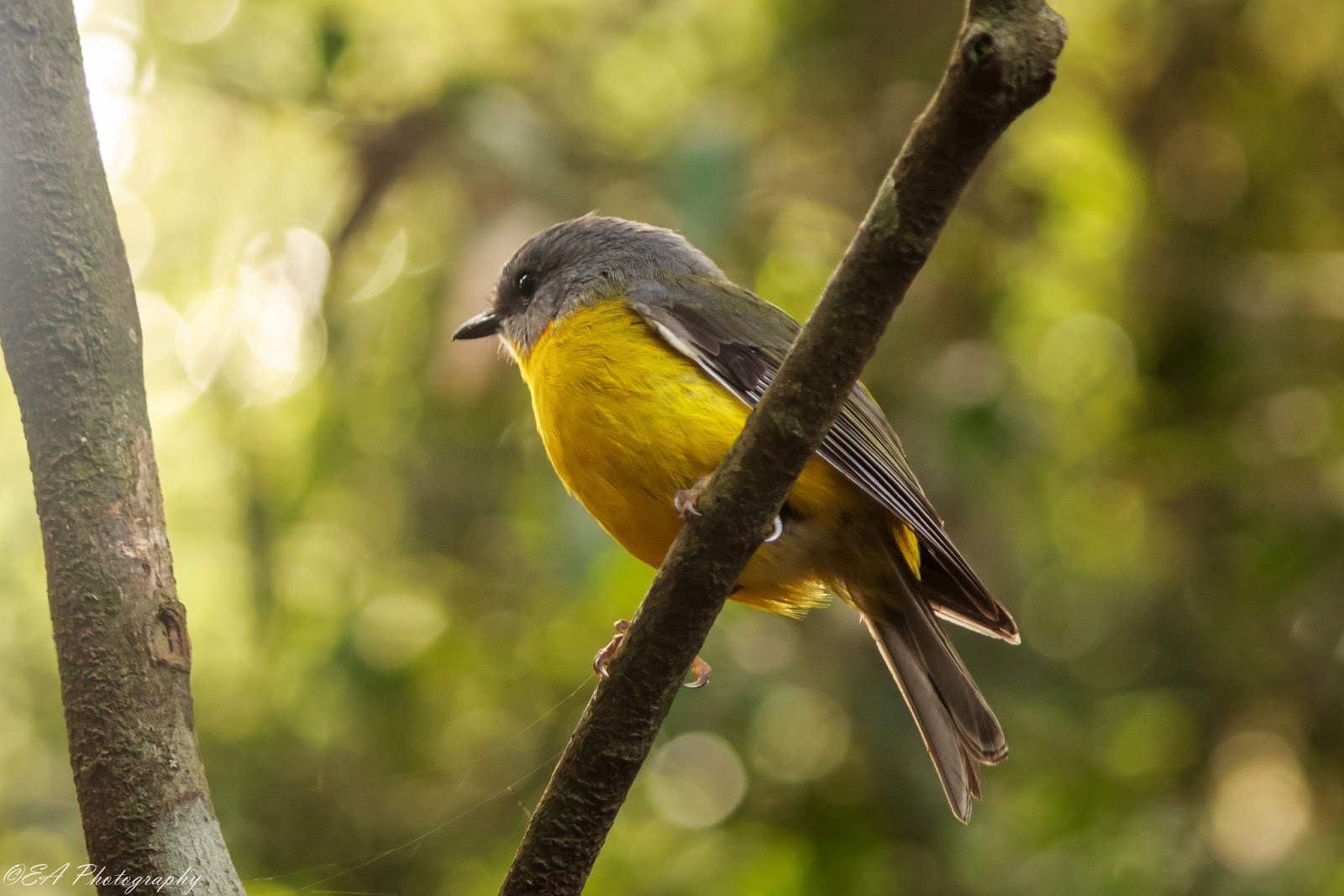
The Eastern Yellow Robin is a medium sized robin. It has a grey back and head, and yellow underparts. Southern birds have an olive-yellow rump, while in northern birds it is brighter yellow. The throat is off-white and, in flight, there is a pale off-white wing bar. The bill is black. Both sexes are similar in plumage colour and pattern, but the female is slightly smaller. Young Eastern Yellow Robins are rufous-brown. The plumage has some paler streaks, which are confined to the wings when the birds are a little older.
The Eastern Yellow Robin is confined to the east and south-east of the Australian mainland. The range is mostly along the coastal and adjacent areas, but does extend quite large distances inland in some areas. Eastern Yellow Robins are found in a wide range of habitats, from dry woodlands to rainforests. They are also common in parks and gardens, and are usually first seen perched on the side of a tree trunk or other low perch.
Linking up with these memes:
The Eastern Yellow Robin is confined to the east and south-east of the Australian mainland. The range is mostly along the coastal and adjacent areas, but does extend quite large distances inland in some areas. Eastern Yellow Robins are found in a wide range of habitats, from dry woodlands to rainforests. They are also common in parks and gardens, and are usually first seen perched on the side of a tree trunk or other low perch.
Linking up with these memes:
Wednesday, March 29, 2017
Wild Bird Wednesday: Rainbow Lorikeet
The Rainbow Lorikeet is unmistakable with its bright red beak and colourful plumage. Both sexes look alike, with a blue (mauve) head and belly, green wings, tail and back, and an orange/yellow breast. They are often seen in loud and fast-moving flocks, or in communal roosts at dusk.
Rainbow Lorikeets are such colourful parrots that it is hard to mistake them for other species. The related Scaly-breasted Lorikeet is similar in size and shape, but can be distinguished by its all-green head and body.
Last week I shared information and images of the Scaly-breasted Lorikeet (also seen below with the Rainbow Lorikeet).
The Rainbow Lorikeet mostly forages on the flowers of shrubs or trees to harvest nectar and pollen, but also eats fruits, seeds and some insects. The Rainbow Lorikeet appears to have benefited from artificial feeding stations and prolific-fruiting and flowering trees and shrubs.
The Rainbow Lorikeet is found in a wide range of treed habitats including rainforest and woodlands, as well as in well-treed urban areas.
Linking up with these memes:
Rainbow Lorikeets are such colourful parrots that it is hard to mistake them for other species. The related Scaly-breasted Lorikeet is similar in size and shape, but can be distinguished by its all-green head and body.
Last week I shared information and images of the Scaly-breasted Lorikeet (also seen below with the Rainbow Lorikeet).
The Rainbow Lorikeet mostly forages on the flowers of shrubs or trees to harvest nectar and pollen, but also eats fruits, seeds and some insects. The Rainbow Lorikeet appears to have benefited from artificial feeding stations and prolific-fruiting and flowering trees and shrubs.
The Rainbow Lorikeet is found in a wide range of treed habitats including rainforest and woodlands, as well as in well-treed urban areas.
Linking up with these memes:
Subscribe to:
Posts (Atom)