Showing posts with label journeys. Show all posts

Wednesday, November 4, 2015

Urangan Pier, Hervey Bay, QLD

Urangan Pier is a historic pier in Urangan, Hervey Bay, Queensland, Australia. It is one of the longest in Australia and stretches for almost one kilometre into the ocean.


It is a former deep-water, cargo-handling facility originally built to facilitate the export of sugar, timber and coal. The pier, served by the extension of the railway line from Pialba, was used for the transfer of cargo between rail and ships. It was built between 1913 and 1917, originally to a length of 1107 metres (1.1 kilometres).


The pier was closed in 1985, and 239 metres of it was demolished. However, due to public outcry, 868 metres of the pier was left, and the land was handed to the Hervey Bay City Council.

By 2009 the last 220-metre section of the pier had been fully restored, and the original timber pylons had been replaced with steel pylons with a plastic covering.


Sharing with these memes:

http://ourworldtuesdaymeme.blogspot.com.au/                        http://asoutherndaydreamer.blogspot.com.au/


Friday, June 12, 2015

Glacier Bay, Alaska

After an exhausting and very late day in Juneau, we woke early the next morning to scenes like this while we ate breakfast on our private deck...

We were heading towards Glacier Bay National Park. While we ate, we continually clicked away on our cameras as the landscape changed to that of beautiful mirror like waters and stunning scenes of rocky mountains, snow & ice. The magical world of snow and ice become more and more spectacular until we reached to toe of the Margerie Glacier.

The Margerie Glacier, a tidewater glacier, was a sight to behold. It is 34 km long and 1.6 km wide and is named after Emmanuel de Margerie, who visited the bay in 1913. It begins at the south slope of Mount Root and flows into Tarr Inlet.


It is the cleanest glacier in Glacier Bay and also one of the most active glaciers for "Calving" (breaking and dropping of ice walls into the sea). The sound is like that of cracking thunder, followed by a rumble and splash as the ice drops into the bay.
The ship stopped here for about an hour slowly rotating 360 degrees so everyone could see. On the bow, staff served biscuits, cheese, champagne & mugs of hot chocolate.

On the miniature icebergs we saw Terns, Gulls and colonies of Sea Lions.

The reflections were as stunning as the landscape...

We were blessed again with more blue skies and subtle cloud formations...


It wasn't long until we were on the move again to John's Hopkins Inlet to marvel at another glacier.

This is the Lamplugh Glacier; a 13km long tidewater glacier with a width of about 1.21 km at the water face. It rises to height of 46-49 m with depth of 3-12m at the waterline.

Here we rotated for another hour, so everyone could enjoy the view from the bow, stern or their private balconies (if they were as lucky as we were).

While in Glacier Bay, we also passed quite close to the Reid Glacier. There were occasional sightings of whales.
This was a magical day in a vast untouched wilderness of snow and ice.


Linking with these memes:

http://skyley.blogspot.com.au/

http://ourworldtuesdaymeme.blogspot.com.au/                        http://asoutherndaydreamer.blogspot.com.au/

Saturday, May 30, 2015

Juneau, Alaska.

After heading out of Seattle on Saturday May 2, through Puget Sound, on Holland America's MS Westerdam cruise ship, we spent a day and a half "at sea" with the coast of Canada and Alaska in sight. I have never seen anything like it; an endless landscape of snow covered mountains.


On Monday May 4, we docked at our first Alaskan port, Juneau.
Juneau is the capital city of Alaska, with a population of 32000 and approachable only by air & sea. Juneau is a gorgeous town with colourful buildings and very welcoming people. 


I was originally booked on a Whales & Mendenhall Glacier photo safari but, due to very high winds, the Whales section was cancelled. I was rather disappointed as I was really looking forward to photographing whales & Orcas in Alaska.
Instead our tour was changed to a Tongass National Forest & Mendenhall Glacier walk, which required hiking 5 miles (approx 9.6km) through a small section of the forest!! The hike was beautiful; the whole area was previously part of the receding glacier and has an abundance of wildlife, moss, Spruce trees and glacial streams... Spruce trees are abundant in Alaska. It was very different to the rainforests in the hinterlands of my home state.

The Mendenhall Glacier is a glacier about 12 miles (19 km) long located in Mendenhall Valley, about 12 miles (19 km) from downtown Juneau in the southeast area of the U.S. state of Alaska. The glacier has also receded 1.75 miles (2.82 km) since 1958, when Mendenhall Lake was created, and over 2.5 miles (4 km) since 1500.
It was approximately 6.5 km hike, from where the bus dropped us off, to the base of the glacier. The landscape was absolutely stunning! We spent quite some time taking photos and walking around the area before returning to our bus.
  

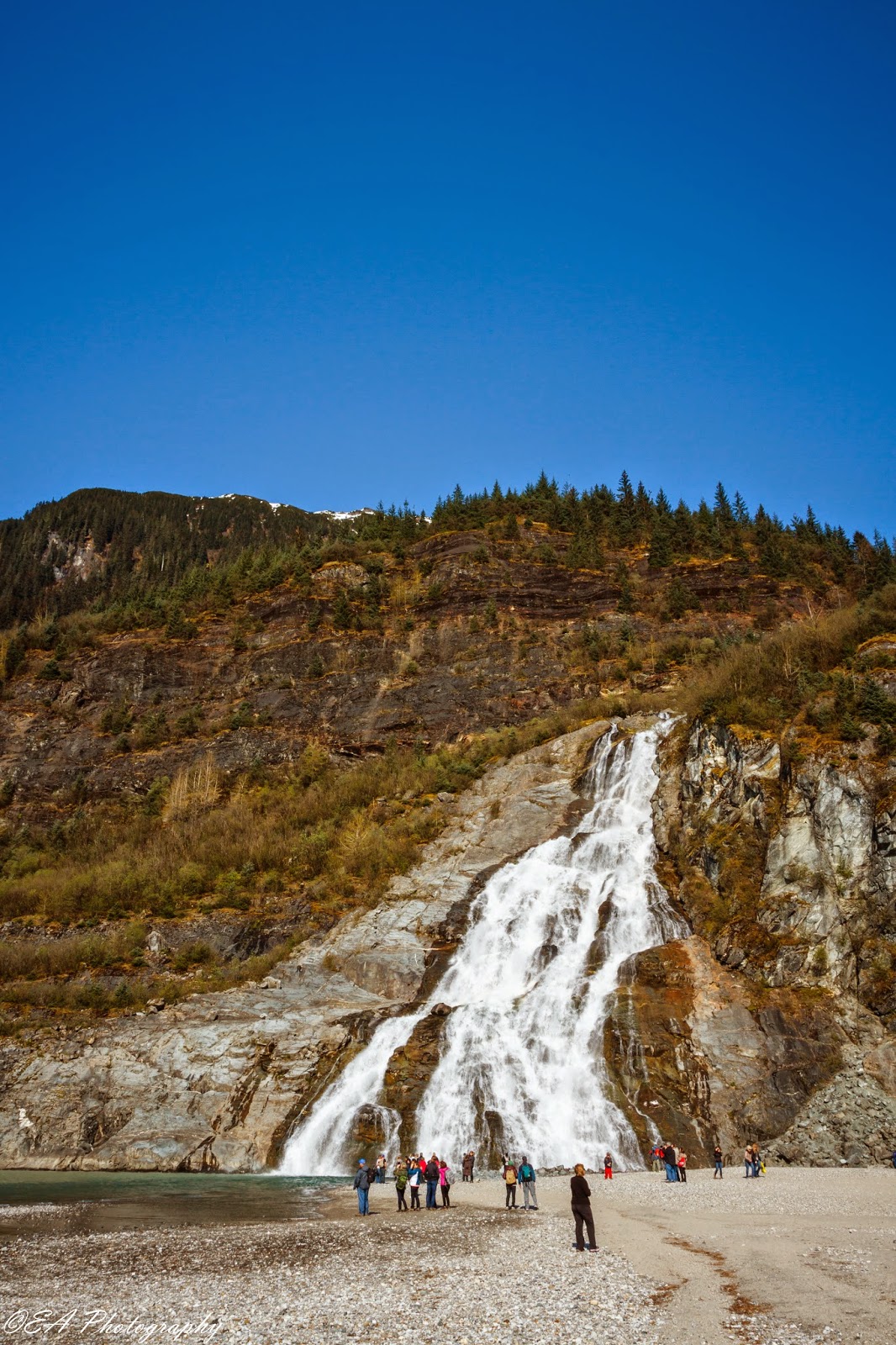
Nugget Falls, also known as Nugget Creek Falls, is a waterfall downstream of the Nugget Glacier. Formed by the creek from the Nugget Glacier, the waterfall drops 115m in two tiers of 30m and 85m onto a sandbar in Mendenhall Lake, which is the freshwater pool at the face of the Mendenhall Glacier.


After we returned to the township of Juneau, I walked around the area, taking more photos, and then got on board the almost vertical Mount Roberts Tramway (gondola) to the top of the mountain to photograph the spectacular views of Juneau and the Gastineau channel. 


I also walked the circuit at the top of Mount Roberts in the snow. By the time I got back to the ship, I was exhausted!


Linking with these memes:


http://skyley.blogspot.com.au/


http://ourworldtuesdaymeme.blogspot.com.au/                    http://asoutherndaydreamer.blogspot.com.au/

Friday, February 27, 2015

A Day at the Zoo - Part 2

On our recent trip to Melbourne over the Christmas/New Year period, we were fortunate to visit the Werribee Open Range Zoo.

It is often said, "It's not what you know, but who you know.", and my husband Michael & I feel incredibly blessed to know one of the zoo keepers of Werribee Open Range Zoo, Paul Rushworth, and his lovely wife Chareen.

We were treated to a private tour and personal up close encounters with some of the fascinating animals that call the zoo 'home'.

Continuing from my previous post, here are some more of the beautiful animals we encountered:

The Zebra - A Plains Zebra has rather broad stripes, especially towards its rump, with colour ranging from black to dark brown. While Plains Zebra are common in Africa, they are vulnerable to loss of habitat and, like many species, to hunting.
Absolutely incredible markings, don't you think?


The Giraffe - Another of nature's beautiful and wonderful creatures.
The giraffe lives in the African savannah and is the world's tallest land animal. There are nine subspecies of giraffe, and all have a characteristic walk, moving the legs on the same side of the body simultaneously. The subspecies are distinguished from each other by their coat patterns and geographical locations.


The Meerkat - Meerkats live in southern Africa, which is dominated by the Kalahari Desert. Finding safety in numbers, meerkats live in groups of 10–30, with a female in charge of each smaller family unit. Meerkats are omnivores and spend most of the day foraging for food.


Kulinda, the Cheetah. 
Cheetahs are the fastest land mammals on Earth, reaching speeds up to 112km/hour, although the average speed of a chase is around 64km/hour. Cheetahs formerly ranged in Asia, Western Iran and throughout Africa except for the true desert areas. They can now be found in the eastern and southern regions of Africa. Their main habitats are open country, from semi-desert to dry savannah, including light woodland.

The Servals.
Morili, on the left, and Nanki, on the right.
These slender and extremely agile cats are one of Africa's most successful hunters. Servals are at risk mainly from habitat loss and degradation. They rely on wetlands, a favoured home of rodents, which comprise the main part of the Serval’s diet.

Meet Morili

Meet Nanki

We felt very privileged to get this behind the scenes opportunity.


And finally, here is Paul (our zoo keeper friend) feeding one of his Serval charges, Morili. We are incredibly grateful for his hospitality.


Linking up with the following memes:

http://ourworldtuesdaymeme.blogspot.com.au/            http://asoutherndaydreamer.blogspot.com.au/
Related Posts Plugin for WordPress, Blogger...